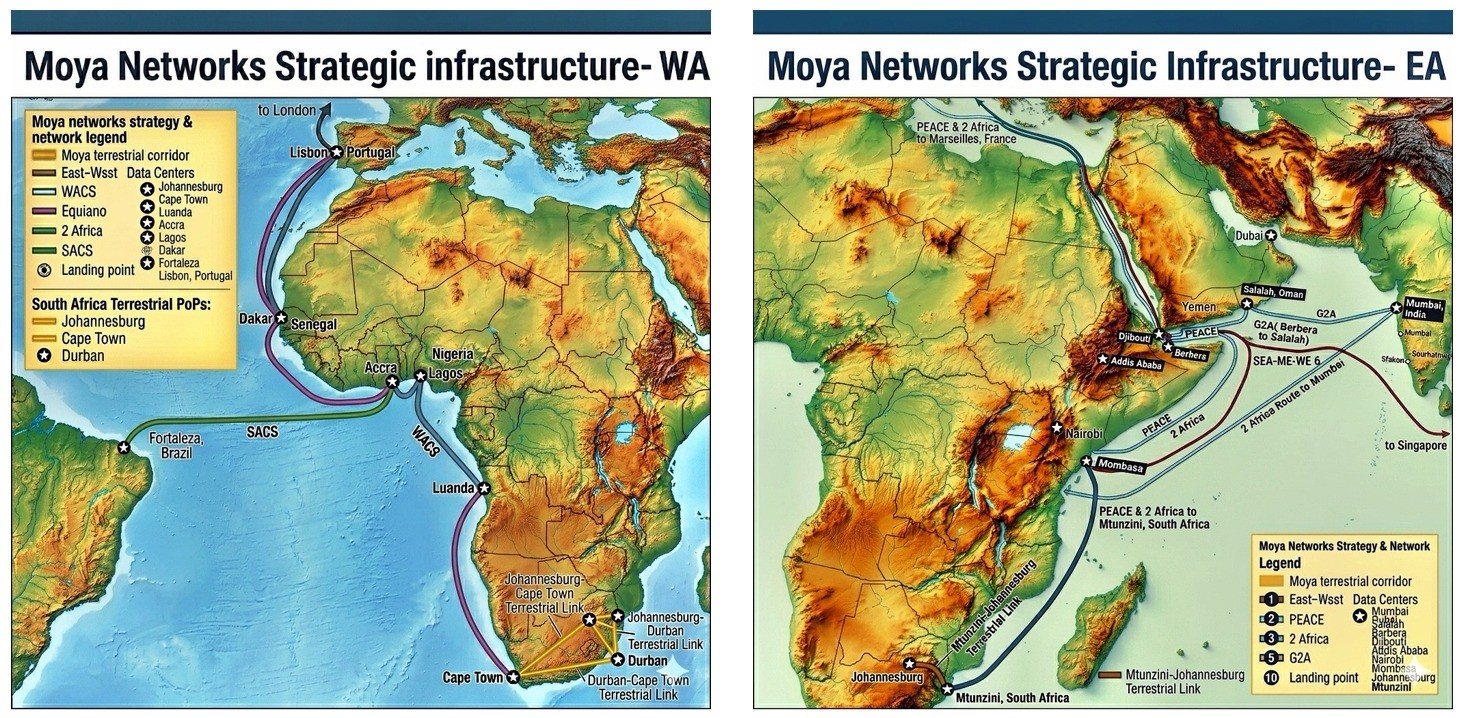
InfraMoyaGlobal builds the physical digital estate, the subsea and terrestrial backbone that binds Africa's principal markets, and the AGI-ready hyperscale data centers at the compute edge of it. The commercial telecoms & connectivity business that monetises this network has its own page. Here is the infrastructure it sells.
A terrestrial fiber spine binding the continent's principal markets, anchored by three hyperscale data center campuses, Cato Ridge in KwaZulu-Natal, Colesberg in the Northern Cape, and Kazungula in Botswana. The platform is designed around three convictions: that AI workloads will follow available power, that data sovereignty will become a regulatory requirement rather than a preference, and that campuses which own their own generation will out-compete those which do not.
Campus capacity is phased over five to seven years toward 100 MW of critical load, beginning with a core pod and regional edge presence, expanding through multi-availability-zone architecture into full hyperscale AI and machine-learning workloads.
Participation in the AAE-2 consortium trunk together with two dedicated branches serving the Horn of Africa. The strategic logic is straightforward: the overwhelming majority of regional traffic presently depends on a single backbone. A second, independent path is not a convenience, for carriers, governments and hyperscalers alike it is a resilience requirement.
Landing infrastructure at Berbera extends inland across an existing 1,600 km terrestrial backbone to Addis Ababa. That backbone is already built and operating, which removes the greenfield construction risk that usually dominates a project of this kind.

The platform is built as an interconnected system rather than a collection of assets. Each node earns its place by serving a specific market, backbone or interconnection function.
Cable landing infrastructure and the gateway function for Horn of Africa traffic, with onward terrestrial reach inland.
The inland anchor, a market of over 130 million people reached over an existing operating fiber route.
East African interconnection and content delivery hub, linking regional carriers and cloud on-ramps.
Cato Ridge on the N3 backbone, Colesberg at the national backbone junction, and Kazungula at the near-quadripoint gateway, binding SADC markets into the spine.
Stable inland hub with clean-energy trajectory, regulatory predictability and resilient regional power access.
Coastal fiber interconnectivity and renewable abundance, forming a redundant dual-node with the inland campus.
Availability-zone segregation with modular expansion, allowing capacity to track demand rather than precede it.
Gas–solar hybrid microgrid with battery storage, targeting 99.999% uptime independent of national grid stability.
Materially reduced water consumption through closed-loop systems, with waste-heat reuse supporting community facilities.
Multiple independent routes and backbone operators, engineered so that no single cable failure isolates a campus.
Detailed commercial information, capital structures and data room access are released to qualified counterparties following screening.